
Feeding fry well from the very first days
F. MattierThe fry of ovoviviparous fish (like the guppy) are already well developed at birth and generally survive easily.
But, in the case of oviparous fish, which make up the vast majority of species, it is quite different.
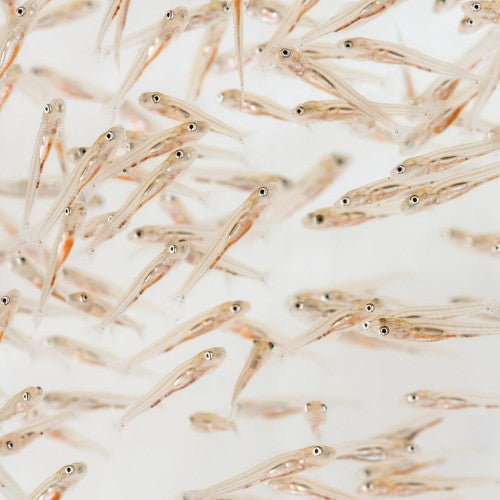
The fry of oviparous fish, when they hatch from the egg, are absolutely tiny. They are often called "larvae," as they bear little resemblance to the adult.
This is why a female danio (zebra fish) can lay hundreds of eggs per day.
Between unfertilized eggs, those eaten by the parents or other fish, and larvae that die in the first days, it indeed takes hundreds of eggs to hope for a few adults in the end.

However, if the risk of predation by the parents is removed, for example by taking them away just after spawning, the main difficulty is feeding these tiny, very fragile little beings.
The very first days are devoted to hatching from the egg, then consuming the yolk sac. Indeed, right after hatching, the fry will settle somewhere and no longer move. Their food needs are then met by this "sac," which contains all the necessary reserves.
After a few days (depending on the species and temperature), this sac is empty, and the fry must absolutely find something to eat. Without this, it dies very quickly, making this stage the critical phase par excellence.

The first food must match the size of its mouth, generally tiny.
This food must also be alive, as the fry is instinctively attracted to movement.
So, it is necessary to provide it with tiny creatures about a hundred microns in size!

These "infusoria," as they are called, are sometimes naturally present in the aquarium if it contains certain floating plants.
Indeed, the small roots of duckweeds, three-lobed duckweeds, Salvinia, or even Azolla teem with infusoria. These microscopic animals find the bacteria they feed on there.
If the water level is low enough, the fry will have no trouble nesting among these plants and hunting what they find.
A much safer and more productive way is to use the famous untreated "paddy rice."
Its germination releases into the water many microscopic species from its original rice field trapped in the grain husks. A few grains germinated a few days in advance will allow you to distribute thousands of infusoria to your babies.
You can also simply let a few grains float directly in the breeding tank, especially if they are kept on the surface by floating plants. The production of infusoria will then be much higher, more varied, and less random.

But there is also a microscopic animal easy to raise, barely longer but especially much thinner than most infusoria. It is the vinegar eel.
This nematode, almost invisible to the naked eye, is raised in vinegar diluted with water.
It is a bit complicated to separate from its medium (you must not pour vinegar into an aquarium!). That is why Aquazolla also offers “ready-to-use” doses: thousands of vinegar eels separated from the vinegar, in clean water. You just have to pour them into the breeding tank: these swimming worms cannot reproduce there but will remain alive and mobile until your fry, attracted by their movement, eat them.
Here is a photo of a very young guppy fry spotting a vinegar eel swimming in the water!

These first foods, easy to obtain, greatly increase the survival rate of your fry.
A fry must indeed "bathe" in food and have a full stomach at all times.
Then, after one to two weeks, you can feed them with micro-worms, which are the easiest, most productive, and most effective breeding. Micro-worms can also be given to guppy or platy fry right from hatching.
It is an almost magical food that allows feeding fry very early and up to the juvenile stage. They will never turn away from it!

The Zollabox Baby allows you to start this breeding, which requires no maintenance since you just have to transfer it each month (there are also simple refills available).

The fry are then able to eat daphnia. They will not eat the largest ones but will feed on those they lay daily.
You will thus have raised your fry with a high success rate, and this without ever resorting to brine shrimp nauplii, which are much heavier, more difficult, and more demanding to produce.
And above all, which do not survive long in fresh water if not eaten quickly.
A bit of paddy rice kept dry, a simple jar of vinegar where vinegar eels live placed in the cellar, and an easy and permanent micro-worm breeding.
With this, you are ready all year round to face a happy unexpected event!
3 comments
Tres bien jadore
Merci pour les infos pour nous les débutants
Je suis très satisfait et apprecier ce document