
Should you clean your fish tank?
F. MattierShould an aquarium be "clean"?
And what does that mean?
When I was young, a lady told me that her son was a passionate and highly experienced aquarist. To illustrate the care he put into his hobby, she proudly explained that he "never put his hands in the water," as an aquarium was fragile and very technical.
It was a time when germs were worrying and the answer was to eliminate them.
Of course, it was known that the aquarium filter contained bacteria.

A filter is what ensures the hygiene of the aquarium.
It has two functions.
One is mechanical: it sucks in and traps all the "impurities" suspended in the water.
The other is biological: it hosts bacteria that break down these wastes, turning them into nitrites and then nitrates, which are less toxic and can be consumed by plants.

So, in the absence of plants to consume them, the filter produces nitrates that accumulate in the aquarium. It NEVER makes them disappear.
But above all, it is now known that, without a filter, the same bacteria do exactly the same work, but inside the aquarium itself. Quite simply.
So, if there is no filter, impurities (droppings, dead leaves, forgotten food…) settle on the bottom and the bacteria, the same as those in a filter, take care of breaking them down in the same way. They are present in the sand, on the glass, on the plants and rocks, and even suspended in the water!
The only difference is therefore only aesthetic: without a filter, there are a few more visible deposits on the bottom, knowing that no filter sucks them all up anyway.
So, filter or no filter, if one does not like the natural look of these deposits, one occasionally uses a "vacuum" that siphons all of this in a few minutes.

Since this observation of the very modest (even negligible) usefulness of the filter for the balance of an aquarium, knowledge has only advanced on microbiotas (the collections of microbes present in the same system).
It is now known that the most varied microbiotas are the most stable. Where one used to buy a small handful of bacterial strains to ensure the famous nitrogen cycle, it is now known that this cycle is ensured by hundreds of species, and the same goes for many other cycles (phosphorus, potassium, etc.).
Just as many modern diseases are caused by a depletion of our intestinal microbiota, an aquarium is all the more stable when it contains a high number of microbial species.
The more different species there are, the less room there is for a newcomer that would want to take over everything, for example a harmful species.
In a complex microbiota, everyone keeps each other in check!

Thus, veterinary medicine has theorized the surprising concept of "clean filth."
It is no longer a question, in breeding, of sterilizing everything, of seeking a perfectly futile total asepsis. On the contrary, such "extreme cleanliness" would give any new microbe coming from outside free rein to multiply, encountering no competition.
Now, the preferred strategy is to tolerate a certain residual "dirt," which actually contains all the microbes to which the breeding animals are accustomed, because they are their own. Their defenses are adapted to them, and their bodies live with them.
It is for this same reason that, when you travel, you fear "traveler’s diarrhea." It is not necessarily due to a lack of hygiene in the country, but mainly because the microbial strains present there are unknown to your body, which therefore does not know how to live with them. If you live longer in that same country, you will no longer have "traveler’s diarrhea."
An aquarium that is too clean is generally unstable.
No natural ecosystem is sterile. On the contrary, all surfaces in nature are covered with microbes (our skin, our intestines, plant roots, a simple stone, a grain of sand…).
It is now estimated that the proportion of harmful microbes is less than 0.5%, even among the viruses that frighten us so much.
The skin of a fish, its mouth, its digestive tract, etc. are made to live covered with microbes.
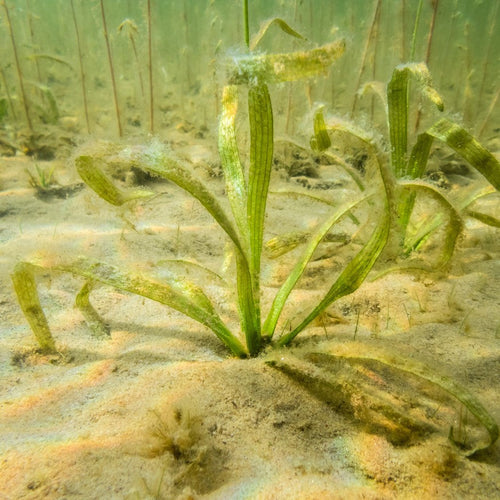
Even plants live completely covered with bacteria, viruses, and even micro-algae, some of which are essential to their health or to the absorption by the leaves of certain elements. An aquatic plant without algae does not exist in nature.

A small daphnia , a pretty Blackworm, a bladder snail or a water louse, when they make a simple dropping, each release several thousand different microbial strains into the environment (between 4,000 and 10,000).
And the water louse does not produce the same as the daphnia , which also does not produce the same as a ramshorn snail!
True biodiversity is actually microbial.
And natural aquaristics, which relies on this biodiversity, uses it instead of fighting it.
Micro-fauna, microbes or algae, nothing really scares it.

A natural aquarium is therefore rather "dirty," but it is proud of it!
4 comments
Merci pour cet article qui confirme ce que je pensais.
Ça y est, j’ai passé le cap. Plus de filtre et plus de poissons dans mon bassin depuis l’année dernière. Je n’arrivais pas à faire cohabiter les bestioles et les poissons malgré mes efforts. Le bassin a virer au vert. L’eau transparente est devenue opaque. Au printemps je l’ai re-inséminé avec des tas de bestioles d’Aquazolla et depuis quelque temps l’eau est redevenue transparente. Je vois des bestioles partout dont certaines que je ne connais pas. C’est passionnant à regarder, très riche. J’utilise une petite caméra faite regarder dans les canalisations pour regarder au fond du bassin. C’est fou, la faune qu’il y a. Des fois un gros dytique passe devant l’objectif attiré par la lumière. Je pense que mon bassin commence à trouver son équilibre. La seule chose que j’ai laissé sont des bulleurs pour assurer l’oxygénation. J’hésite encore à les retirer, pourtant avec les plantes oxygénantes qu’il y a, ça devrait le faire. J’y vais doucement. C’est un vrai changement de paradigme. Je ne touche plus au bassin. Je le laisse tranquille et j’observe.
Encore un excellent article. Un copain biologiste me disait qu’un aquarium était une fosse septique pleine de bactéries qu’il ne fallait surtout pas nettoyer sans arrêt sinon on détruisait l’équilibre du bac.
Merci pour ce bel article! Un pas de plus sur mon chemin un peu tortueux pour me passer du filtre de mon 240l. Pour le moment, je suis à mi- chemin, avec introduction de planobre d’ asselles et consorts, mais toujours avec un filtre