
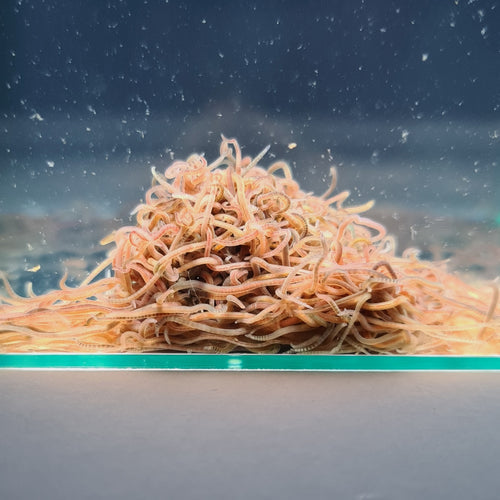
How do Blackworms reproduce?
F. MattierAmong the aquatic invertebrates offered at Aquazolla, I have a strong fondness for the Blackworm.
Food that fish adore (some even call it the "caviar" of fish!), this pretty worm is truly interesting in its own right. I personally have an aquarium without fish, entirely dedicated to it.

The Blackworm is related to our well-known earthworm. Let’s say it’s a cousin.
Its scientific name is Lumbriculus variegatus and it is strictly aquatic.
Its color is reddish-brown, but the magnifying glass that sits beside every good critter aquarium actually reveals a far more complex anatomy than a simple "brown spaghetti"!
You can easily see its "blood" system pulsing like a heart, and a fascinating translucent body, always moving inside.

In the wild, besides serving as food for fish, the Blackworm lives half-buried in the substrate. Head down, it lets its rear part dance in the water, which it uses to breathe.
At the slightest alarm, it fully retreats into the sand or mud.
It is precisely in the substrate that it finds the organic waste it feeds on. Like its distant earthbound cousin, it does not feed directly on decaying matter, but rather on the microorganisms they host.
It is therefore a detritivore, insofar as it participates in the breakdown of organic "waste".
But it is regarding its mode of reproduction that this already fascinating worm becomes even more so.
Indeed, its sexual organs have been identified in the laboratory. Its sexual reproduction is therefore perfectly possible.
And yet, although it has been studied thoroughly for decades in laboratories worldwide, no one has ever witnessed a single mating!
Its sexual reproduction is therefore possible in theory, it may sometimes occur in nature… but no one has ever proven it.
Because, on a daily basis, this worm reproduces by dividing itself.
But for the Blackworm, it is true.
At certain stages of its life, a part of its body becomes fragile, and it splits in two at the slightest movement of the substrate. The wound, which has been prepared, is then light, and both pieces each give rise to a new individual.
When you raise Blackworm in sand as I do, it is enough to gently stir the sand they live in from time to time to softly cause this break and speed up the multiplication of individuals.
And this without sex!
This worm is so fascinating that it has its rightful place in a "critters" aquarium, with no fish to make it their meal!