
Grindals and enchytraeids, perfect food?
F. MattierTo know what the best foods for fish are, isn’t the simplest way to observe what they eat in the wild?

Fish mainly eat very small aquatic prey (insect larvae, worms, crustaceans such as daphnia, etc.). The principle is that a fish eats anything alive and of a size compatible with its mouth. In the aquatic world, one can say that everyone eats everyone else, provided they have a mouth of the right size!
And this means one thing that is too often forgotten. Since fish eat only critters (or almost), they cannot function like us.
Our metabolism uses carbohydrates for energy and proteins as building material for our body. If we have to use proteins for energy, it works poorly.
Because we are not flesh-eaters.

But the aquatic world does not offer carbohydrates to fish!
Our aquarium fish are almost all flesh-eaters, even if some nibble a little algae which provide the only rare carbohydrates in their menu.
Fish therefore have a metabolism totally different from ours.
Their body produces energy from proteins and fats (lipids). It does not use carbohydrates since it is not made to encounter them in its natural environment.
Most artificial fish foods, however, contain carbohydrates, often from grains. Their main interest is industrial, since starch allows giving coherence, a “binder” to the paste which will then be rolled out (flakes) or extruded (pellets). Without this “glue,” the food would be a simple powder.
Grains are, however, totally absent from the natural diet of fish.
They are an oddity for them.

If you feed your fish with real small worms suited to their size, such as enchytraeids or Grindal worms, you will provide them with a menu similar to what they are made for.
These worms that live in moist soils (often the banks of water points) contain a protein rate of… 70%! That is huge (minced beef is around 20%), but it matches the needs of fish. The fat content is 5 to 10%. The legend that says these worms are too fatty to be given every day is therefore false, and also ignores the fact that fish metabolize fats differently than we do.
No manufacturer today knows how to produce a food that has the composition of an enchytraeid or a Grindal worm (or even a daphnia), which also provide many and complex minerals, natural B-group vitamins (and not synthetic vitamins produced in a laboratory).
Grindal worms and enchytraeids, easy to raise, allow you to always have at home what is needed to ideally feed your fish. With a menu that suits them and not an industrial food that appeals more to humans than to their stomach!
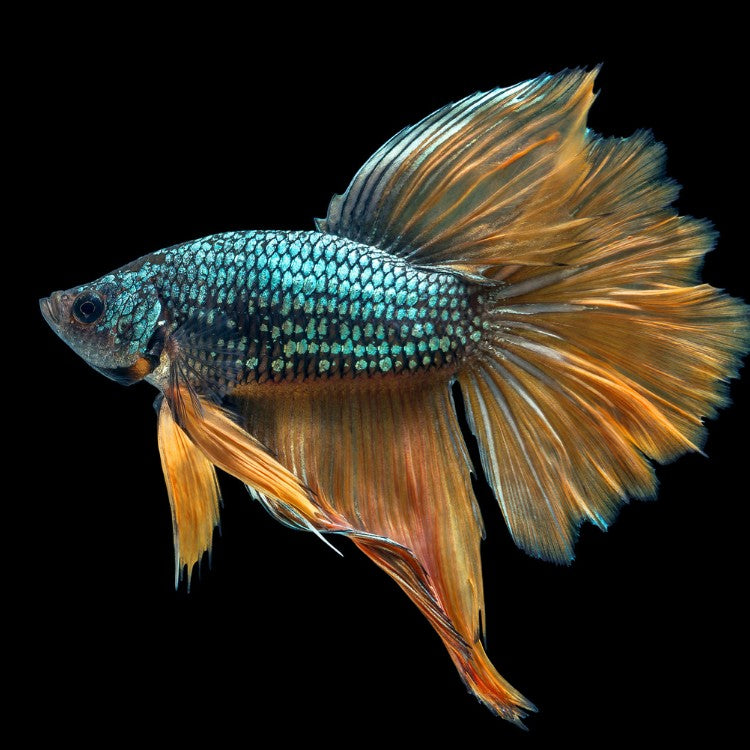
Grindals, smaller, will suit modest-sized fish and large fry, and enchytraeids will delight Bettas, adult or large fish (angelfish, discus, etc.).

They are easy to raise because, not being truly aquatic animals (they live somewhat between land and water), they do not require a water tank, regular water changes, etc.
They are content with a suitable pot, a moist substrate, and food given in small amounts from time to time.
The Zollabox Fish S (Grindal worms) and Fish L (enchytraeids) allow setting up a small breeding without advanced knowledge, since even the food, a complete manual, a suitable pot, the substrate and even the starter culture are provided!

Room temperature suits Grindals and enchytraeids generally prefer 15 to 18°C.

These small breeding setups allow having an endless supply of natural and complete food for our aquarium fish.

And for ponds?

These worms naturally live in humus-rich and especially moist soils, so why not place some in various spots along a well-moist bank?
If there is enough organic waste (dead leaves, etc.), they will be able to live there, just as they find their place in your compost heap.

You will improve the decomposition of your compost heap (or composter) by introducing strains of these worms, which will find ideal conditions there to multiply and fulfill their natural role as decomposers.
In short, feeding your fish with natural food is better for them, but it is also an exciting adventure of observation and discovery of a biodiversity we forget to look at, in the garden or elsewhere.
1 comment
C’est tellement vrai. En nourrissant mes bettas imbellis avec du vivant, ils changent de couleur quand ils chassent, c’est impressionnant comme ils deviennent bleu/noir et redeviennent couleur claire quand ils ont fini…. D’ailleurs, ils ne veulent plus de granulés!!!! Heureusement j’habite dans le Sud, les moustiques ont commencé à pondre, ils se régalent 😉.