
Grindals: for which fish?
F. MattierEveryone has noticed it: fish love to eat worms.
Mud worms, Grindal worm, enchytraeids, mosquito larvae, micro worms and vinegar eels for fry, etc. Anything shaped like a worm pleases them more than anything!

But why?
In fact, except for a few special species (like the fearsome piranhas or sharks), fish do not have their teeth at the entrance of the mouth, but at the back of the throat. As a result, what they eat can only be chewed if it has managed to enter their mouth.
That is why, when you see them fail in front of a daphnia a little too big for them, they spit it out and you notice it is intact and starts swimming again as if nothing happened.
A large tasty creature can therefore only be swallowed by a fish if its shape and size allow it to pass its teeth, and thus its throat.

Hence the innate interest of fish in small elongated animals: their slenderness, if the fish swallows them the right way, allows them to easily pass the mouth barrier.
That is why, for example, fry too small to swallow anything other than infusoria swallow without problem vinegar eels, which are larger but very slender! Infinitely more slender, in fact, than brine shrimp nauplii.

It is also why Grindal worms, very easy to raise, suit so many different sizes of fish. Big enough and white enough to be seen by all adult fish who love them, their slenderness also allows very young fish to enjoy them. From two-week-old guppies to adult angelfish or discus, this very attractive white worm is probably the most universal natural food in fishkeeping.
A Grindal worm culture in full production (after a few months) gives you more than enough to regularly feed your fish, from small neon tetras to large gouramis, including your juvenile livebearers who will cautiously but very excitedly watch the few worms that escape the big ones!
Biologically, the Grindal belongs to the same genus as the splendid enchytraeid, much larger and therefore less suitable for small fish.
In nature, fish often find them on the shores, where water meets the plant litter and humus in which Grindal worms and enchytraeids live.
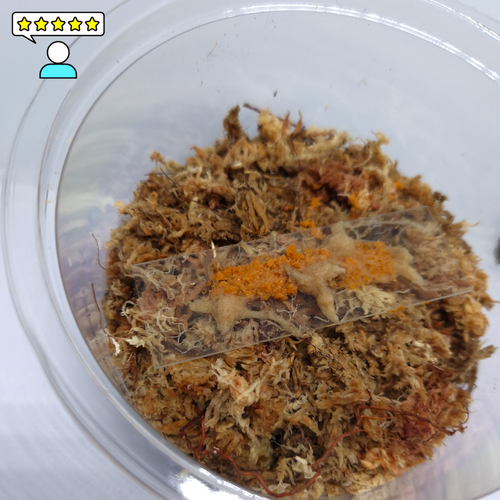
That is why Grindal worms are so easy to raise in sphagnum moss (untreated), like the one provided in the Zollabox Fish S, which allows you to start this small discreet, space-saving, and odorless culture easily at home.

To be informed of the release of future articles, remember to sign up for the free mailing list at the bottom of this page!
1 comment
Bonjour
Effectivement il est très facile d élever ces charmantes bestioles
J en ai placé dans de l humus naturel au jardin bien au frais et bien protégé du soleil
Problème : grand espace (ancienne brouette hors d usage) et hop je ne peux plus les voir
J ai placé les autres dans la zoobox qui me sert de protège lumière (tout se recycle) et ils grouillent
Bon ensuite comme je suis un cœur d artichaut je ne les donnent pas aux poissons . On ne se refait pas , je préfère les regarder……..
Merci F. Mattier (Florian Florent Félix Fabio…,. Je cherche je cherche)
Encore un bel article
Bonne journée à tous