
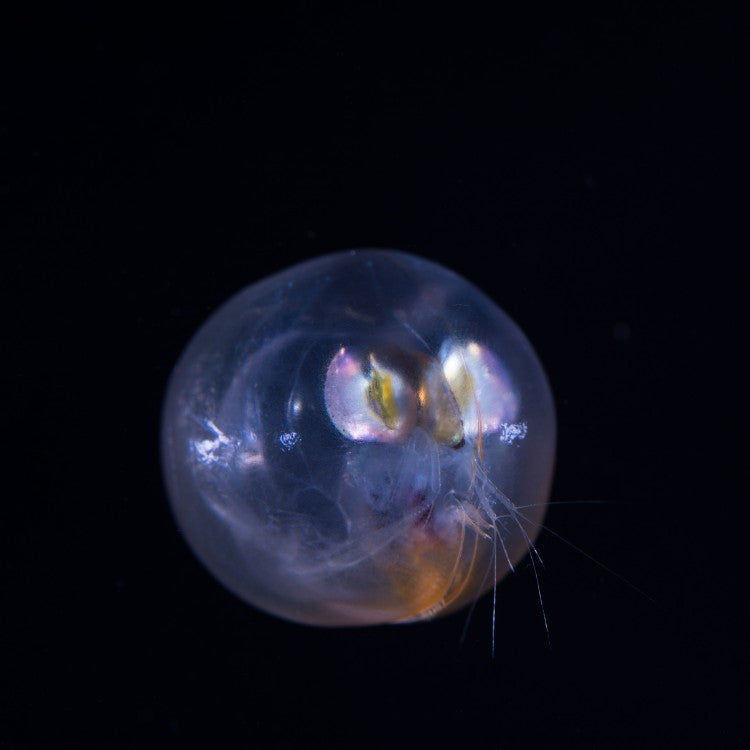
7 amazing things to know about seed shrimps!
F. MattierOstracodes are largely unknown animals. Coming from deep Prehistory, their interest in aquaristics has only recently been discovered. Here are 7 things you might not have known about ostracodes. Are they useful? Do they only serve to make you look smart at dinner parties? You decide!

1 – Are ostracodes friendly?
The answer to this question is not known. However, there is scientific certainty: they do not have a heart!
These tiny critters don’t need one; the path their vital fluid must travel is not long enough for evolution to invest in such a useless organ.
Ostracodes, for the vast majority, are therefore heartless individuals.
2 – Can we make omelets with their eggs?
It will be very difficult, as they are extremely resilient, beyond even your imagination. Ostracode eggs can withstand long droughts and extreme temperatures.
And, since we are talking about consuming them, it turns out some have tried: fish and birds. Well, it turns out the eggs even resist the acidic gastric juices of these animals, allowing them to travel sometimes very far and, once "disembarked" from the "plane" in their droppings, to populate a new space, like a new pond for example. This is how ostracodes are found absolutely everywhere there is water, even in some temporary puddles in fields.
But neither fish nor birds have ever told us if these omelets taste good.

3 – What record is held by male ostracodes?
Ostracodes may be among the smallest animals in the world, but they hold a very enviable and completely useless record.
Indeed, they have the largest sperm cells in the animal kingdom. Some male ostracodes end up with sperm cells 3 times longer than their own body!
Of course, this is not very useful since, like daphnia, they reproduce mostly by parthenogenesis: females produce new females without mating. But when mating does occur, it is spectacular: both males and females have 2 genital organs. For males, these are called two "hemi-penises." So mating is a bit like plugging in an electrical socket!
The two species offered by Aquazolla are fascinating in this regard, as they lay eggs in groups forming egg plates (often bright orange). Not everything is known yet about this collective behavior.

4 – What do baby ostracodes look like?
The babies are the spitting image of their parents! Ostracods, once hatched, will have 7 to 8 successive larval stages. But from the first stage, they look like a miniature adult and are just as capable of swimming or walking and eating the same things.
Between each larval stage, the baby ostracod molts. It sheds its old shell made largely of calcium carbonate, then secretes a new one in less than a day. Ostracod molting is remarkably fast.
5 – How many dozens of species exist?
Just in freshwater, scientists, armed with very very strong magnifying glasses, have already described 15,000! And a scanning electron microscope is needed to identify them. Dissecting the shell is almost always necessary. Let’s have a thought for this little-known profession: ostracod microscopist, for which, one imagines, very small fingers are required!
And that’s nothing considering that ostracods are mostly marine. There are therefore more than 60,000 known species (some fossil) and new ones are discovered every day…

6 – An ostracod, what does it eat?
Although rare parasitic species are known, practically all ostracods are detritivores. This means they feed on dead organic waste, fallen on the ground or on various surfaces (rocks, plants, etc.). Ostracods are the main cleaners of aquatic environments. In some seas around the globe, tens and even hundreds of thousands per square meter have been counted in places! We can almost speak of "living sand," with all waste being recycled by these extraordinary and yet largely unknown animals.
When you know the role of ostracods in aquatic ecosystems, you realize that our pink ramshorn snail is more there to decorate than to work!

7 – Is the ostracod a microbe?
No, it is far too large to be classified as microbes, since it can be seen with the naked eye. Our ostracods measure 1 to 2 mm maximum, but there are smaller and even larger ones (a few centimeters). Ostracods are actually crustaceans, like water lice, daphnia, shrimp, or lobsters!
They are an important member of the zooplankton (animal plankton) in nature, and a food source for fish, including fry.
You could say that in nature, a fish that has never eaten an ostracod does not exist!
To learn more about ostracods, read this other article by Mattier: here
2 comments
La dernière fois que j’en ai mis dans mon aquarium je ne les ai pas vus!!! Mangés aussitôt???
J’aime bien cet article, très bien écrit et avec une pointe d’humour. J’ai acheté des ostracodes mais je ne les vois pas. Ou elles se cachent, ou elles ont servi de déjeuner 😄