Live ostracodes: essential micro-cleaners for natural aquariums and low-tech ponds
What is an ostracode?
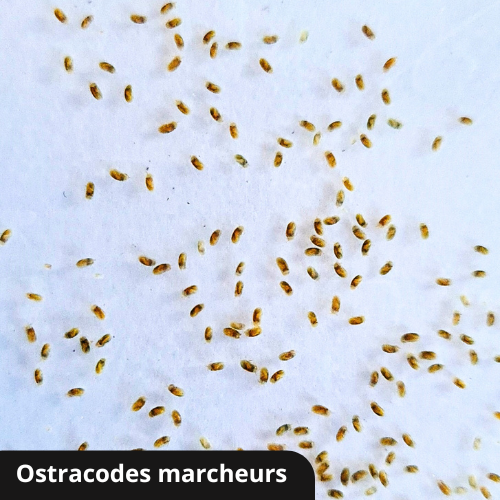
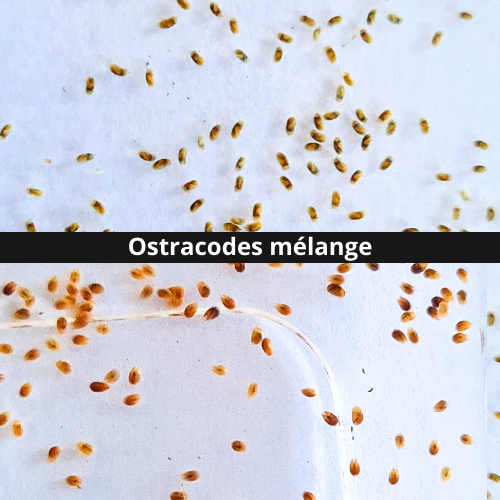
Ostracodes are tiny crustaceans (0.5 to 1 mm), protected by a bivalve shell resembling a small "bean seed." Moving on the substrate or briefly swimming depending on the species, they clean by eating microalgae, organic particles, and biofilm. If food scraps or a carcass are present, they rush to consume it. Even shrimp or daphnia molts suit them!
Present on Earth for over 400 million years, they form the first animal link in the aquatic food chain and naturally stabilize the nitrogen cycle in any planted tank or trash aquarium.
Very close to daphnia, they feed on walls and surfaces while daphnia eat particles, algae, and bacteria suspended in the water.
We offer two different species of ostracodes, one strictly walking (brown) and the other swimming (orange).
Why introduce ostracodes?
- Continuous purification: transform microscopic waste into nutrients immediately available for plants.
- Complete biological cycle: fulfill the "living filter" stage in a pump-free aquarium, a key step in biological cycles often missing in aquariums.
- Self-regulating population: multiply only if food is abundant.
- Useful biodiversity: provide a varied microbiota beneficial to fish, snails, and shrimp, and especially to the entire ecosystem, aquarium or pond, stabilizing and balancing it through biodiversity effects.
- Food reserve: edible, they serve as a natural snack for fish in case of scarcity, as they are less appetizing than other live foods.
Introduction and maintenance tips
- 🏠 Simply pour the batch of 30 ostracodes into the destination tank, after a basic acclimation: equalizing temperatures and gradually exchanging the water.
- 🌙 Choose a quiet area or dusk for them to settle. You can also use the free part of the sump to install them away from fish if there are any.
- 🍽️ No dedicated feeding: the tank waste and biofilm are sufficient for them, so feeding them would not make sense.
- 🔍 Observe reproduction: still poorly known, their reproduction is collective, with many individuals laying and caring for eggs arranged in "plates" on glass or various supports. These plates are brown to bright orange and often contain hundreds of eggs. Keep a magnifying glass near the aquarium!
- 🌡️ Ideal temperature: 10 - 28 °C, but they tolerate much less (survive the harshest winters outside) or more (very active during heatwaves).
- ⚡ Avoid strong pumps: especially for the swimming species (yellow), ostracods could be sucked into the filter.
FAQ - Ostracods in natural aquariums and ponds
Are ostracods dangerous for fish?
No. They are not parasites or predators. They are completely peaceful and too small to harm or stress your inhabitants. It is rather the fish that eat the ostracods!
Can they proliferate in a troublesome way?
Their number strictly follows the amount of available waste; in a well-maintained tank, they remain discreet. They only proliferate in environments where no other species can live (heat, total anoxia, bacterial invasion, etc.).
Will they cloud the water?
On the contrary: by filtering biofilm and microparticles, they help clarify the water. Regarding green water, they do not filter it, unlike daphnia. But they eat the microscopic algae that compose it as they settle on the bottom.
Can they live outside in a pond?
Yes, as long as the water does not freeze completely. They perfectly tolerate seasonal variations and just need some liquid water remaining, not frozen.
Is special filtration or aeration needed?
Not necessary. They develop perfectly in a low-tech planted environment without any additional equipment.
Additional information
Species: we raise and offer a swimming species of yellow color and a walking species of brown color. They are complementary.
Packaging: batch of about 30 individuals (indicative weight: 12 g)
Guarantee: raised without any chemical treatment, entirely naturally, without direct or indirect contact with fish. No wild collection.
Recommendation: as a principle and precaution, please never release these organisms into the wild.