
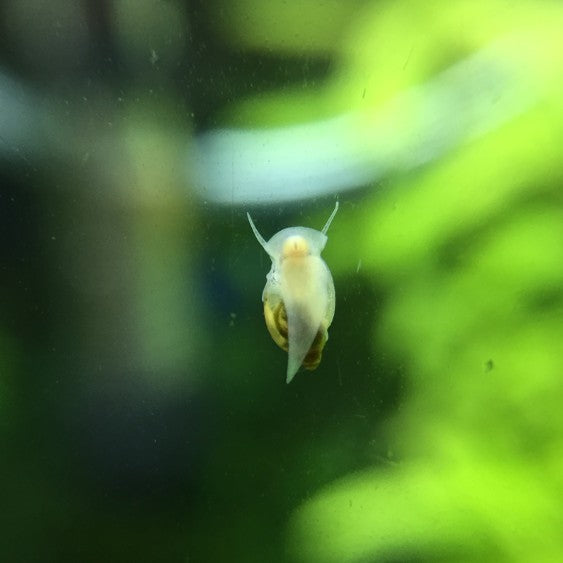
Snails: why are they so essential?
F. MattierIn natural aquaristics, where the balance of the aquarium is above all a concern, it is unthinkable to do without snails, whether in aquariums or outdoor ponds.

But why?
Of course, we are all happy to see a new species arrive in our little ecosystem, and each new snail is already a pleasure in itself. We have an aquarium, it is true, primarily for the joy of watching a small aquatic world with its inhabitants evolving there.
But the reason why these snails are indispensable must be sought elsewhere.
As I have often explained, the biological cycle of a fish-populated aquarium is broken; it is not complete.
And this has a very simple explanation: fish are far more numerous in aquariums than in nature.
In a natural pond, each fish has for itself, on average, between one and ten cubic meters of water (i.e., 1,000 to 10,000 liters). It is with this very low density that the aquatic ecosystem functions normally. The micro-fauna is abundant, and fish are at the top of the food chain. An insect laying eggs in a pond has a good chance that some of its offspring survive the fish and manage to fly away one day.

Not in an aquarium.
The fish density is a thousand times higher there!
Needless to say, with fish swimming around all day in such a small volume, no tasty critter has the slightest chance of escaping them.
It is exactly the same as giving a hen a hectare of meadow or just 10 square meters all year round. Few chances that a single blade of grass or a worm remains in the second case.
The aquatic biological cycle, which requires the presence of a numerous and varied micro-fauna, is therefore broken in aquariums and thus incomplete.

Fish eat everything that tastes bad for being alive and bigger than a bacterium!
The function of this micro-fauna, which is largely "detritivore," is therefore not fulfilled.
And its function is precisely to reduce organic waste into particles that can then be attacked by microbes. In the absence of these critters, bacteria are left alone to degrade without help organic elements that are too large and complex.

For example, in nature, green water is a blessing: it nrots the daphnia, which then feed the fish who, as if by chance, reproduce at the same time.
In aquariums, green water becomes a problem precisely because the slightest daphnia will be gobbled up before starting its work. And the water will become greener and greener, until the microscopic algae that make it up die en masse, seriously polluting the water. Hence the principle of the ZollaBox Clear Water, which allows the daphnia to do their work.
The same goes for fish carcasses: ostracods that should consume them are banned, eaten too quickly. Only water lice, a bit bigger and tougher, manage to settle if the fish are not too big.

That is why snails are so precious. They are part of these detritivores, but they are the only ones able to keep fish in check thanks to their shell.
À In the presence of the very rare fish that eat them, snails can work and live quietly without being devoured. And they are practically the only detritivores capable of this.
It is therefore almost only thanks to snails that an aquarium with fish can regain a complete biological cycle.
Personally, I turn my back on tropical, exotic snails, which we do not know what to do with if we stop fishkeeping and which sometimes colonize natural spaces if released there. This was the case with apple snails, very popular with aquarists and now banned for this reason.

The only exception I make to this principle are the malaysian Trumpet Snail (above). Because they do not survive the winter in our latitudes and therefore are not likely to be invasive. And above all, they are the only ones to bury themselves for a good part of the day, thus ensuring a micro-mixing function of the soil that plants appreciate.
Otherwise, the ramshorn snails have become a classic of the aquarium, with their different color varieties.
But their tiny cousin, the planorbids, is practically unknown. Fascinating and discreet, it is a true curiosity of nature.

The bladder snail, small, amusing (it sometimes swims on its back!) and respectful of plants. Unlike its cousin the great pond snail, which sometimes nibbles on them when it has no more algae to eat. Both complement each other wonderfully in the pond, the great pond snail loving to come out of the water to take a nap on a floating frogbit leaf or on an iris!

In a "creature" aquarium, with or without shrimp but without fish, the micro-fauna can live safely. All species form a constant ballet and offer the spectacle of the natural cycle.
But snails, less irreplaceable in this case, remain visible and aesthetically valuable actors, adding their species to the overall biodiversity.
6 comments
Très intéressant comme toujours ! Les escargots font partie du biotope d’un aquarium, même si quelque fois un peu envahissants
Oui c’est toujours agréable et instructif de vous lire. Merci beaucoup.
Merci, comme toujours, c’est très instructif
Merci beaucoup pour cet article fort instructif.
Toujours interessant merci