
Can fish safely eat Tubifex?
F. MattierTubifex worms, which make up a significant part of fish diets in the wild, are a prime food for those wishing to mimic natural conditions.

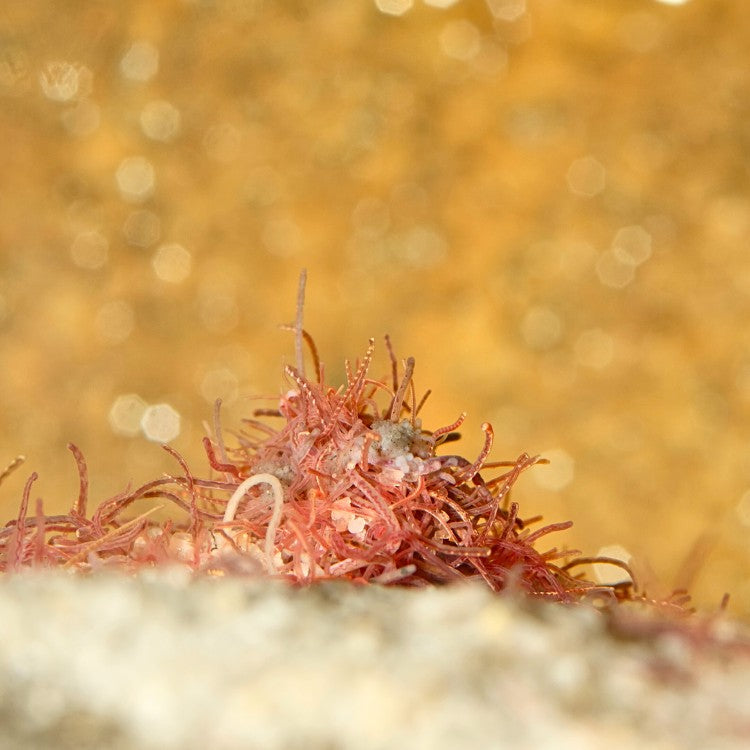
Very close in composition to Blackworm, this segmented worm is rich in proteins and hemoglobin (hence its color).
It is much thinner than its lookalike and generally smaller as well.
But, since it is on the fish menu, evolution has naturally led many parasites and pathogens to choose it as a host to reach their target.
Moreover, this worm is a very active decomposer and purifier, central to the recycling of waste in aquatic environments.
When the water is very dirty and heavily polluted, even smelling bad due to lack of oxygen, it is often the only animal still living there.
The Tubifex worm can live for several months without oxygen!

This is an example of remarkable specialization: being a decomposer of organic matter, it is equipped to survive in environments that contain a lot, even too much, of it.
The downside is that, in these polluted environments, it accumulates all sorts of filth in its body!
That is why it is absolutely unthinkable to collect it from the wild to feed your fish. Parasites, microbial pathogens (streptococci, staphylococci, Mycobacteria, Myxobolus, etc.) and even heavy metals often end up inside its body.

Even after long "purging," the risk remains.
The solution is therefore to raise it in a controlled way, in a very clean environment, and only obtain it if it comes from a serious breeding operation.
Just as mud worms caught in the wild (often from Poland) should be reserved for anglers and never for our fish, wild Tubifex worms are to be avoided in fishkeeping.

On the other hand, when you want to raise Tubifex worms, or even introduce them into a critter aquarium (without fish), you discover a fascinating animal, with behavior close to that of Blackworm, since it also buries itself halfway into the substrate, leaving its tail sticking out and waving, through which it breathes.
The big difference with Blackworm, besides its much smaller size, is that it can reproduce both by dividing (like Blackworm) and by laying eggs, making it more prolific. It can also form cysts in dormant forms to resist complete drying out and then revive later!
Thus, sometimes a wild duck landing on the edge of a pond without Tubifex worms can, simply by dropping some dried mud stuck to its feet from the previous pond, magically introduce these worms into the new environment.

If you want to raise Tubifex worms, a few simple rules:
- raise them alone (and obviously without fish)
- provide a clean bottom substrate (simple sand is enough)
- introduce an air stone
- change the water (very) often, as they dirty it a lot
- be patient: like all invertebrates, they need their microbiota to settle first in the environment before they start multiplying properly (for example, Grindal worms sometimes take more than a month to be visible outside their substrate).
- feed them with clean and even disinfected food by boiling it: this way, they will only be colonized by microbes present in the breeding tank and will introduce nothing harmful!
- or give them micronized spirulina in small amounts, which is even simpler.
For harvesting, some use a piece of Perlon (cotton also works) in which worms settle and which can then simply be placed in the fish tank.

Because a clean Tubifex worm is a true pleasure without risk!
1 comment
Super intéressant, j’en élève et je viens de comprendre (et d’apprendre) comment mieux faire, merci beaucoup pour cet article 🙏 . Signé : un passionné de culture de nourriture vivante 😉