
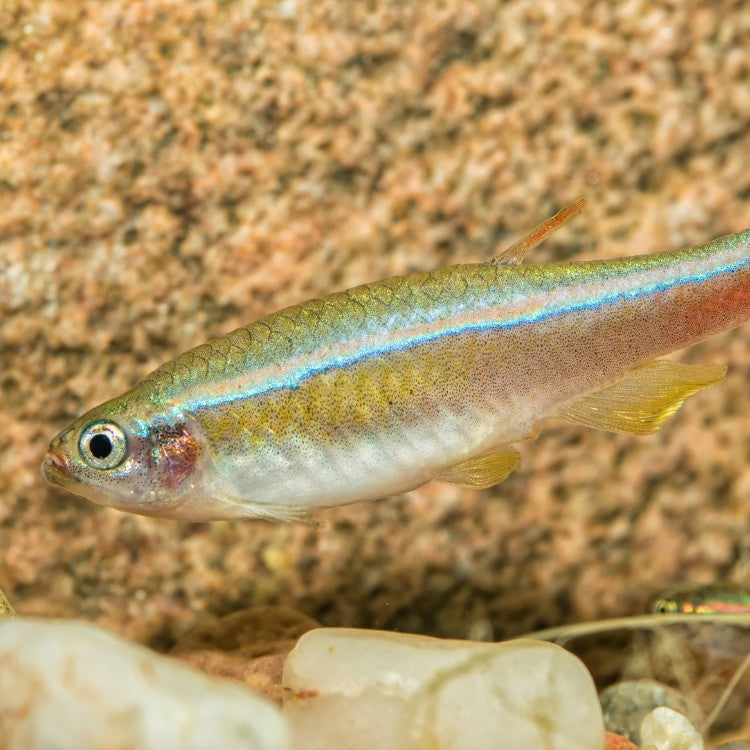
The Tanichthys, so happy outside!
F. MattierThe Tanichthys, also called the "poor man's neon," is a flagship fish of natural fishkeeping.
After my female guppy in 2004, which accidentally led to the creation of the poubellarium concept, the Tanichthys was the obvious first fish to continue the adventure.
It was reputed to live between 5 and 26°C in my fishkeeping manual.
Some research on its original habitat convinced me that it was the ideal candidate to live outdoors year-round.

Indeed, in the Chinese mountains where it lived before nearly disappearing, it faced a climate quite close to ours. The small streams where it was found wound through banks covered with snow in winter, and the water did not freeze simply because it was moving.

This small fish, which likes to live in groups, has limited needs. Its weight, more than 200 times less than that of a goldfish, says a lot about its metabolism. A few mosquito larvae, some daphnia, and a few worms fallen from the banks are enough for it. Consider this: a school of 200 Tanichthys weighs the same as a single poor goldfish!
While a goldfish swims in circles in the 1,000 liters of a small pond, your Tanichthys have enough room to swim in all directions, chase each other, spawn, and so on. A few bunches of plants quickly become a small jungle for them…

And, while most of my fish could only spend the summer outdoors in a poubellarium, the Tanichthys can stay outside permanently. Since the question of retrieving them at the end of the season does not arise, it then becomes possible to offer them a true pond, a nearly natural and vast playground at their scale.
In winter, they live under the surface ice, in conditions quite close to their origins, then living with a slowed metabolism.
These colder temperatures give them a longer lifespan than they would have in an aquarium at 24°C year-round. Indeed, the metabolism of a fish slows down or speeds up according to the surrounding temperature (cold-blooded animals), and this one is made to face cold seasons unlike tropical fish.

I personally have a preference for the veil variety ("long-fin"), whose fins are longer but in a very reasonable way. Its silhouette remains harmonious and natural, and its colors are slightly brighter. But a Tani given back to the wild life takes on colors almost unknown in an aquarium anyway. Happiness makes our fish more beautiful…
You will enjoy it little, since nature gave it an olive-green back meant to camouflage it from the eyes of the bank predators, who see it from above.
Your pleasure will rather come from knowing it is happy, guessing the groups moving among the plants. A light bottom (pebbles, sand…) will make them much more visible.

These fish are also small enough not to devour everything living in your pond. Even though it is very important never to introduce them into a natural pool (a natural pool should not receive fish), you can, with a nice pond, create a very pretty mini-pool, planted and even flowering, which will attract dragonflies, frogs, or even newts, your Tanichthys being, due to their size, able not to wipe out the other species. Another huge advantage over goldfish.
And to be even more certain, just introduce a lively group of 20 Tanichthys into a pond of 1,000 or 2,000 liters. They will form an observable school from the bank, while leaving room for all other forms of life.
The natural fishkeeping that Aquazolla supports aims to give life to the water, not to sterilize ecosystems!

If you put in more (the temptation is great!), you would then have to feed them properly, as the pond's resources would no longer be enough. This compromise will allow them to have at all times some daphnia depending on the season, ostracods living on the bottom, and so on.
Fish well-being, pleasure in knowing they are happy year-round and reproducing naturally, compatibility with a garden aquatic ecosystem… This fish actually has all the qualities to become the discreet inhabitant of a world on the edge of wild and familiar, one that is accessible to us while reserving every day the surprises that only nature can provide.
5 comments
Mes Tanichthys (achetés en animalerie) ont passé l’été et l’hiver dernier dans une auge de maçon de 90 litres, achetée 13 euros chez Leroy M. La moitié du volume était occupée par un papyrus. Dans cette auge vivaient déjà des Néocaridinas, des planorbes, des physes et certainement d’autres squatteurs venus durant c’est quelques mois passés à l’extérieur.
Au début du printemps, j’ai tout transféré dans une piscine hors sol d’environ 2000 litres, dénichée pour 20 euros sur Le Bon Coin. J’y ai ajouté des iris des marais, pontédéries, myriophiles, cératophilles, pistias, un nénuphar et des lentilles d’eau. L’ancienne auge a été simplement posée telle quelle dans le bassin.
J’y ai rapidement introduit un petit groupe de 5 Corydoras. Puis, avec l’arrivée des beaux jours, j’ai ajouté un trio de guppies. Les naissances ont explosé pour les tanychtis et les guppies. Les corydoras fond leur vie en cachette, avec les chaleurs actuellement l’eau s’est bien troublée et ils restent peu visibles.
Ce qui m’a vraiment surpris, c’est la vitesse de croissance des alevins en extérieur par rapport à un aquarium classique. Ça pousse vraiment vite.
Quand le froid reviendra dans notre beau département du 13, je récupérerai les guppies pour les hiverner à l’intérieur. Les Tanis, eux, resteront dehors : s’ils ont survécu un hiver sans problème dans 90 litres, je n’ai donc aucune inquiétude dans plus de 2000 litres.
Une bonne idée pour remplacer les poissons rouges en bassin même si ces derniers restent quand même très attachants avec leur bouille, leur grosse bouche et leur comportement familier 🤗 mais chez moi j’ai trop peur qu’ils se fassent manger (hérons, chats…) et qu’ils ravagent tout avant…! Peut-on mettre des tani dans un bassin de 500l sans filtre ou est-ce trop petit ?? Merci pour vos articles 👍🏻
Bonjour,
Suite à votre article j’aimerais acheter des Tanichthys pour mon bassin. Pouvez vous me conseiller un site dans lequel vous avez confiance et où je pourrai en acheter ? Merci d’avance !
Nina
Bonjour à tous,
J’ai un poubellarium de 1000 litres avec dedans des daphnies, des aselles, des crustacés divers, des crevettes red cherry, des planorbes et tout se petit monde de porte à merveille ! J’ai envie d’y intégrer 5 tanichthys mais j’ai peur qu’il massacre mon biotope même si vous indiquez dans votre article que tout ira bien. Pouvez-vous me rassurer ? Bonne journée
Bonjour ,
Comme d’habitude excellent article . Pour ma part j’ai choisi les Notropis Chrosomus pour mon bassin de 2000 en RP . Le Tanichthys sont en aquarium .