
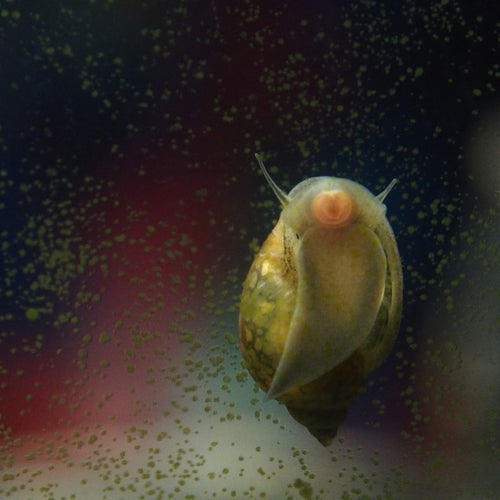
The bladder snail: a true eater of algae
F. Mattier1 – How can you recognize the bladder snail?
Formerly known as Physa marmorata, its new name is Stenophysa marmorata.

The bladder snail is a very pretty little water snail whose size does not exceed 1 cm. Only a few very rare "giant" individuals exceed this size. To distinguish the bladder snail from its cousin the great pond snail, you need to look at its shell from the back: if you see it coil clockwise up to the tip, then it is a bladder snail. The great pond snail coils in the opposite direction.
As it grows, the bladder snail is also distinguished by the appearance of spots or marbling in all shades of brown, hence its scientific name.
The bladder snail is "lunged," meaning it breathes at the surface and not underwater like fish, and it does not have a hardened operculum to protect itself when it withdraws into its shell, unlike the melanoides.
2 – What does the bladder snail eat?
The bladder snail is primarily an algae eater. The basis of its diet, from the moment it hatches, is algae. Apart from algae, it only eats decaying tissues (dead plants or animal remains), and even bacteria. This is what makes it amusing: its irresistible way of swimming on its back at the surface actually allows it to feed on the film of bacteria and algae (the "biofilm") that forms on the surface of water bodies.
For the bladder snail to attack a healthy plant, it really must find nothing else. This is what makes it so popular in aquariums and ponds, as it limits its plant diet to algae and dead or sick tissues!

3 – How does the bladder snail reproduce?
Like many snails, the bladder snail is hermaphrodite: it carries both sexes. It therefore mates with any other individual, each fertilizing the other's eggs!
But it also has the ability, if it does not find a partner for a long time, to resort to parthenogenesis: it then produces offspring without mating. This means that a single individual, in an aquarium, will eventually reproduce and populate the space after a long wait.
The bladder snail is even the first animal in the world in which "castrator" genes have been identified, capable, in some individuals, of sterilizing their male part and thus turning them into pure females.
The eggs of the bladder snail are enclosed in a transparent "jelly" attached to any support. Over the days, the white embryos appear, then hatch. They only turn brown later and eat algae from hatching.

4 – How to house it?
In a pond, the bladder snail lives quietly and even passes the winter without any difficulty. Its population naturally adapts to the available algae. Its small size allows it to reach all corners, but also occasionally to serve as a meal for a large fish or amphibian.
Since the bladder snail is, in the natural environment, the host of certain parasites and pathogens that can affect fish, it is not recommended to introduce individuals from your pond into an aquarium.
Aquazolla breeds bladder snails without contact with fish for several generations to avoid this risk.
In an aquarium, it will not experience winter and will live at the same pace all year round. It will eat algae, but also any corpse or food waste you might have missed. It thus becomes the health insurance of the aquarium.
Do not feed it specifically, or it will lose this virtue.
Also remember not to leave it in an aquarium where the surface is very close to the edge. Indeed, like the great pond snail, it has the habit of coming out of the water from time to time and could then escape, with no hope of survival.
Finally, the bladder snail is one of the few snails to tolerate very soft, even acidic water, although it obviously prefers water richer in minerals for its shell.
5 – Does the bladder snail pollute the aquarium?
If you do not feed it, it will not pollute the aquarium at all: indeed, it only recycles elements already present in the aquarium, contributing to the cycle of recycling various wastes. Its droppings contain only nitrogen and phosphorus that it took from the algae and not from outside the aquarium! And the aquarist will generally prefer a snail dropping, which will feed their plants, rather than an alga!
The bladder snail is therefore a strict "detritivore," constantly recycling elements already present in the ecosystem, never bringing any from outside.

6 – How to limit its population?
The bladder snail is small. This is part of its charm, but it makes its capture difficult and tedious if it becomes too numerous.
First of all, remember that its population increases when algae and food waste increase. It is only the symptom, and even the remedy!
If you limit external inputs (especially fish food), it will therefore be less widespread.
The introduction of glossiphonids (tiny harmless leeches) can limit their number, as they will attack the smaller ones. But this remains a very moderate predation, and some glossiphonids can sometimes, for lack of better, prey on the Blackworm, or even shrimps and water lice.
But, in a natural aquarium, these cycles of moderate predation among various critters are also somewhat what is sought, right?
7 comments
J’adore ces petites bestioles. Mais je ne comprends pas je n’arrive jamais a les faire proliférer pourtant j’ai des algues !!
merci bonnes information sur ce charmant petit escargot!!!
Merci pour cet excellent article que j’ai lu avec plaisir !
Merci pour cet excellent article que j’ai lu avec plaisir !
J’adore les physes : petites, jolies et si utiles et discrètes ! J’en mets partout (aquariums, bassins) et elles ne prolifèrent jamais chez moi, contrairement aux envahissants planorbes (mais jolis et utiles aussi) qui me bouffent régulièrement des plantes saines et peu d’algues… Je ne comprends pas leur mauvaise réputation !