
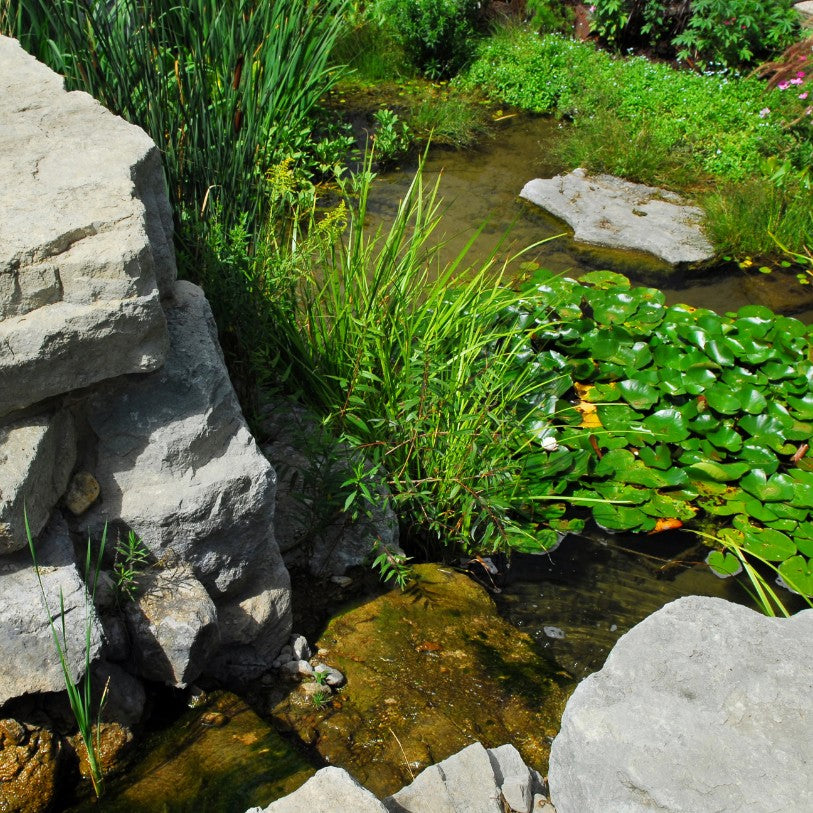
The same plants in the fish tank and in the garden?
F. MattierFor more than twenty years now, my aquariums have extended into the summer garden in the form of trashcan ponds.
I originally created this concept in 2004 to give my fish a summer holiday!
With the idea that taking the opportunity to give a bit of wild life back to the fish could only be good for them. And this was proven true, with fish more colorful and lively in the autumn.

But this trashcan pond concept was not meant to last through the winter.
Yet, over the years, my trashcan ponds have increasingly remained set up year-round, with fish in summer, without fish in winter.
They gradually became true micro-ponds, where the seasons follow one another, and the plants live their life all year long.

Logically, I began to look for plants able to live both in aquariums and ponds, capable of growing at 24°C, as well as surviving winter under the ice.
And finally, I stopped using the most tropical, most fragile, most demanding plants... which in the end are neither more beautiful nor more essential than my “hardy” ones!

That is how I have in my aquariums only plants that I can take outside in summer with the fish, or even leave outside all year, replant inside, and do this endlessly!
Natural fishkeeping is not a search for a “French-style” water garden, requiring regular human intervention and costly technology.
Little by little, I continue to offer on Aquazolla these versatile plants, just as comfortable indoors as outdoors, that grow on their own, foolproof.

The Vallisneria gigantea is part of this group. Only very small aquariums will not suit it. But otherwise, in aquarium, trashcan pond, or year-round pond, it grows on its own, consuming nitrates and phosphates at the pace of its rapid growth.

The large duckweed, superb in aquariums, has a great advantage in ponds: it is not eaten by carp and goldfish, while they feast on the small duckweed that serves as their greenery!
In winter, the large duckweed survives at the bottom of the water and thus only disappears in appearance. These dormant forms start growing again in spring.

The large Bacopa and the water hyssop, provided their roots are well at the bottom, out of reach of the ice, can also live outside year-round. But growing them in an aquarium is also a pleasure, as their tender green is pleasing. In an open aquarium, they will rise above the surface to flower, as they do outside in summer.

And of course, the stars are Hornwort, elodea, and Egeria najas, all three very oxygenating and able to be left in ponds year-round, or grow without limit in aquariums, heated or not! They fight algae thanks to certain molecules they emit, which is as valuable in aquariums as in ponds.

I have been testing dozens of others for several years, and some are already very convincing.
Creating small wild worlds at home and in the garden, with the same plants.