
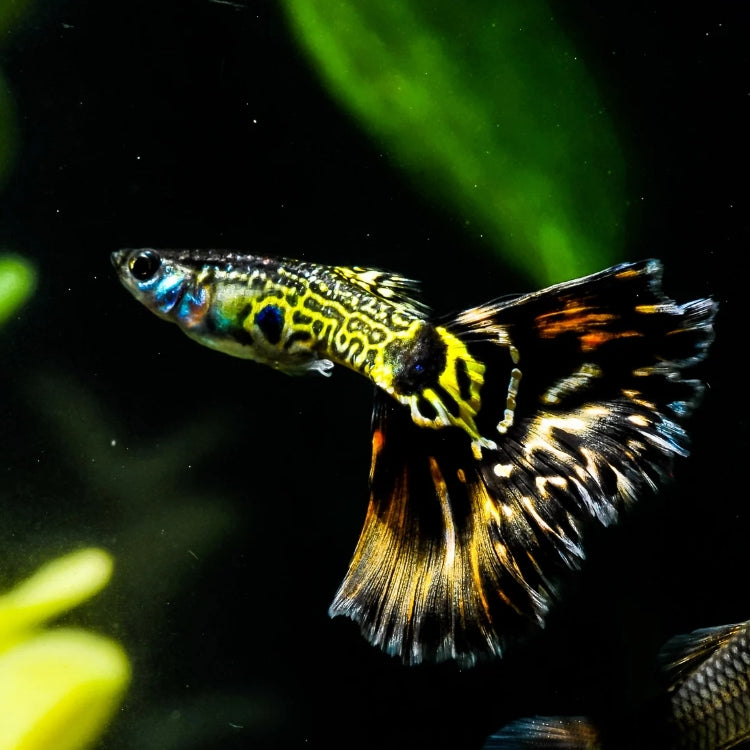
Guppy: the mosquito repellent?
F. MattierNicknamed the "million fish," the guppy has been introduced worldwide to fight diseases spread by mosquitoes. With what limits and drawbacks?

When I started fishkeeping (the dinosaurs had just barely disappeared!), it was because a school friend lent me a book. It revealed the basic principles of the aquarium and the traditional list of fish species with their photos.
And I still remember the guppy’s picture, at the top left of the page I had reread hundreds of times! This fish fascinated, charmed, and enchanted me. The text called it the "million fish" because of its prolific breeding.
The photo showed dozens of males together, packed like in the pet shop’s aquarium, and it was a wonder of colors. The book said this fish had been deliberately introduced in many countries because of its voracity for mosquito larvae, to fight malaria.
The sadness of fish flakes!
Then I had aquariums and guppies (in French, it should be written "guppys," but oh well). I fed them with the only food available at the time in my provincial town: the little yellow box with fish flakes! How far away the mosquito larvae were...
Never did the poor guppies of my youth see a daphnia or a mosquito larva, nothing fun to hunt or as tasty as in the wild.

My 2004 guppy, the one who was the pioneer in discovering the trash bin aquarium, was the first to benefit from my desire to end this industrial, dry, and artificial feeding. I wanted her to regain a form of wild life.

So I suppose she spent the summer hunting mosquito larvae that laid eggs in her trash bin aquarium at the back of the garden.
The trash bin aquarium: an anti-mosquito solution?
I quickly realized that the trash bin aquarium could be the equivalent of what has been tried in many countries to fight mosquitoes, anopheles carrying malaria and tiger mosquitoes carrying dengue, Zika, or chikungunya.
Because the guppy is now present in nearly 70 countries outside its original area, almost always introduced deliberately, and sometimes even under the WHO’s guidance.

But, while studies show that the guppy readily settles and eats many mosquito larvae, they do not conclusively show that it alone is enough to reduce the pressure of mosquito-borne diseases.
The guppy prefers other live foods
In reality, even if the guppy eats mosquito larvae, it much prefers bloodworms, chironomid larvae (non-biting midges), as well as the famous daphnia.
So the guppy does have an influence on ecosystems but not as much as one would hope on mosquito populations.

In Nigeria, a recent observation even showed a completely null effect against biting mosquitoes.
A guppy population was discovered in mainland France, near a thermal spring (and therefore warm). There is a rather harmful pressure on local species and the natural ecosystem.
Introducing the guppy into the natural environment is something to absolutely avoid. Climate warming means that even in France, we must be cautious to prevent fish "escaped" from aquariums from settling.
Fish in trash bin aquariums: it works
Still, the trash bin aquarium can be a good way to fight mosquitoes.
The stagnant water of the trash bin aquarium (or pond) attracts female mosquitoes who lay eggs there. And this mistake is fatal to their offspring, since the fish present will leave no larvae.
Because, in a trash bin aquarium, they cannot gorge on bloodworms and necessarily turn to what they find.

But this also works well with platies, swordtails, and many other fish, of course.
Fighting mosquitoes in other ways?
There remains the ethical question.
If you offer a nice summer in the garden to guppies from your aquarium, then they clearly benefit, and so do you.
But if you buy them for this sole purpose, it may be different, and a trash bin aquarium without fish is probably preferable, with beautiful plants and aquatic creatures.

Because we will see in a future article that there are many other ways to fight mosquitoes attracted by ponds or trash bin aquariums, without necessarily using fish.
And those who want to bring life to a pond without putting fish in it, to enjoy a rich and wild fauna, will see this as excellent news!
8 comments
Merci pour ce nouvel article aussi sympa que tous les précédents . Le Guppy reste efficace en poubellarium , en petit comme en moyen bassin . J’ai en RP un 2000 litres et toutes les larves mangées sont autant des moustiques piqueurs de …. moins .
Nota : pour les Passionnées : malgré que mon bassin ait une profondeur de 080 m , les Guppys sont rentrés dès que l’eau atteint 18° .
A bientôt
Merci pour cet article très intéressant. J’ai hâte de lire la suite car je me suis lancée récemment dans le poubellarium pour nourrir ma combattante. Et elle adore ! J’ai d’ailleurs trouvé beaucoup de conseil ce votre blog.
Merci pour vos articles toujours intéressants et scientifiques sans pour autant se “la péter”. J’attends avec hâte l’article sur le poubellarium pour lutter contre les moustiques sans être obligé d’y mettre des poissons…
J’attends avec impatience l’article pour lutter contre les moustiques dans un poubellarium… Merci encore pour tous les articles intéressants, scientifiques et surtout… qui ne se “la pète pas” comme d’autres que l’on peut lire ailleurs…