
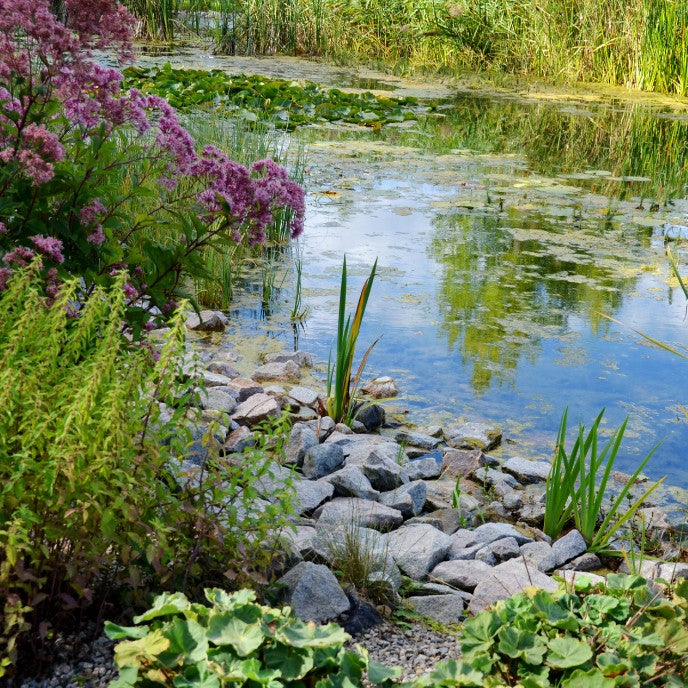
Pools: here we go again!
F. MattierOf course, it depends on the regions.
Of course, there will still be frost, perhaps even snow.
But spring is truly here, already awakening our ponds and basins.

While the earth slowly warms from the surface, aquatic environments do the opposite: the bottom has remained frost-free, generally between 5 and 8 degrees depending on the depth.
This is how our goldfish and carp have been able to survive.
Because under the sometimes thick ice, the water has remained increasingly mild as the depth increased.
The frogs, which spent the winter in the basin’s mud, sheltered from frost, are timidly beginning to emerge. They are already snapping up the first insects that skim the surface to lay eggs in the water. Midges and Chaoborus are already active on sunny March days and form the first food for the predators waking up, including our fish.

If one is very observant, one can sometimes spot at the bottom of the basin, just above the dead leaves decomposing there, the first colonies of daphnia. They are multiplying right now in the few centimeters at the bottom, where life is reborn, already offering them some bacteria and sometimes rare planktonic algae.
The fish are not yet active enough to wipe them out, but their coming abundance will trigger the spawning of our fish.
It is the daphnia which, at the bottom of basins and ponds, truly announce spring, offering the emerging food chain its first, essential link.

Not filtering, not using a pump, allows this natural order, still subtle and imperceptible, to unfold. Let us not let our human obsession with cleanliness sterilize our basins!

The reproduction of water lice took place much earlier, and hundreds of tiny individuals have replaced the previous generation. They are almost invisible, but they are everywhere under the leaves, on the smallest plant debris, waiting for the arrival of the algae they will feed on during the season.

By being very attentive and observant, you will see on the edges of the basin the purple loosestrife, which seemed dead, budding from the base. This summer, their splendid flower spikes will exceed a meter!

The water mint has already made good progress: its creeping stems have lengthened and have already formed vertical shoots a few centimeters tall. Again, the more they are underwater, the more advanced they are! Always that mildness coming from the bottom...
The marsh iris, of which only the rootstock remained, is also reborn. It is pushing out its first tender green leaves. It too will take its ease, growing year by year.

The thermal inertia of water is very strong. These are cubic meters (and therefore tons) of water that have kept enough warmth to use the sunlight right now. Aquatic ecosystems are therefore leading the race, while the surface earth is struggling to come out of the last frosts and warm up.
And if you do not yet have a basin, create one! Or even, if you prefer, simple ponds, small or large, and you will do your part in preserving a very fragile biodiversity. A simple lively water point, and it will benefit frogs, dragonflies, hedgehogs, and many other animals, not only aquatic. These water holes will moderate the temperatures around them, both in heat and cold, thanks to their thermal inertia.
They will bring a beneficial ambient moisture to the vegetable garden or near a flowering hedge.

Aquarists, we who love and understand aquatic ecosystems, let us create them everywhere. Nature is increasingly lacking them.