
Water plants and flowers
F. MattierWhen one thinks of water plants, one often imagines rushes, reeds, or mosses that one does not imagine flowering.

The flower of the pond, for the general public, is mainly the water lily, or even the lotus.
And it is true that these plants bloom beautifully.

But almost all aquatic plants flower, sometimes even in aquariums.
Those that do not flower are ferns. The Sumatran fern (Ceratopteris Thalictroides) and the Microsorum (Microsorum pteropus) belong to this family; they reproduce differently. The Microsorum has sporangia (brown-orange dots) under its leaves like the ferns in our forests. These spores, somewhat like those of mosses or mushrooms, are a means of sexual reproduction replacing flowers. But these ferns can also produce babies, new small plants, on their own leaves. Each small plant is then detached by the current and goes on to live elsewhere.
But the others are flowering plants.

The Lobelia (Lobelia cardinalis) is well known in aquariums, but if set free, for example in a pond, it produces a superb red flower cluster in summer.
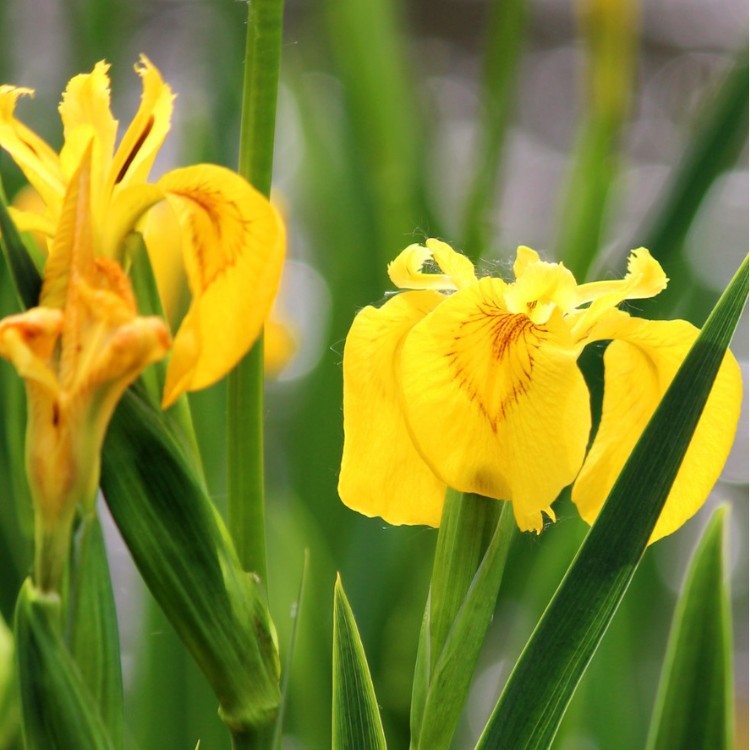
Likewise, the marsh iris shows off its beautiful yellow flower in spring, which brightens so many of our ponds, temporary or permanent. For the marsh iris (Iris pseudoacorus) even survives without water, in ponds that dry up in summer.

The purple loosestrife forms spikes of mauve flowers in summer, so beautiful that they are gladly made into bouquets.

And let's not speak of water mint, whose very pretty flowers irresistibly attract nectar-gathering insects that delight in its fragrant nectar.
But true aquarium plants also flower.

The best example is the large Bacopa (Bacopa amplexicaulis) or water hyssop (Bacopa monnieri), present in most aquariums. Their desire to flower is such that they sometimes make their small blue flowers underwater.
Of course, in this case, the flowers rot quite quickly.
But if the plants rise above the surface, the flowers are more numerous and produce seeds. In ponds, these are thus flowering carpets of countless small fragile blue flowers emerging from shallow areas.

The elodea, on the other hand, never rises above the surface. It is a plant that cannot stand being out of the water. But if its stems lengthen at the surface, in the sun, delicate flowers appear at water level. Their crumpled tissue-paper look and ivory color are unmatched. The elodea flower (Elodea densa to those familiar) is one of my favorites for its fragility.
Let's move on to flowering plants without petals, like Eleocharis, whose spring flowers seem insignificant but are real.
To finish (but there are so many others), an example of flowering underwater!

The very common Hornwort, the famous "Hornwort," only produces its flowers in the water. They have no petals and are separated on the stem between male and female flowers. They form little "buds" that can be mistaken for buds or a tiny snail firmly attached!
The originality of the Hornwort is that its flowers open underwater and the pollen goes to fertilize the female flowers, still underwater!

The fertilized flowers will form fruits containing seeds… again and always underwater.
These so diverse leaves that delight us in our aquariums are ultimately only a very limited aspect of the plants we think we know so well.
2 comments
Bonjour,
Merci pour toutes ces explications qui sont toujours un plaisir à lire ! J’aurais une question au sujet du sol d’un aquarium low tech pour qu’il puisse bien accueillir les plantes et bien sûr jouer son rôle “d’épurateur”: quel type de substrat préconisez vous et quelle épaisseur doit-il avoir s’il vous plaît !
Merci d’avance !
Vos présentations sont toujours IMPECCABLES mais là ….. il manque si ces fleurs / plantes sont gélives , caduques ou non .