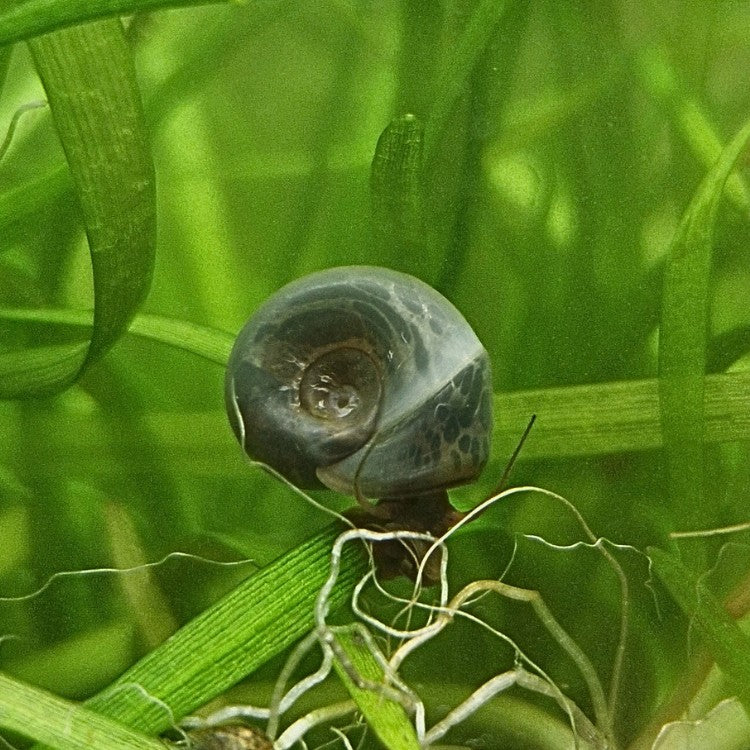
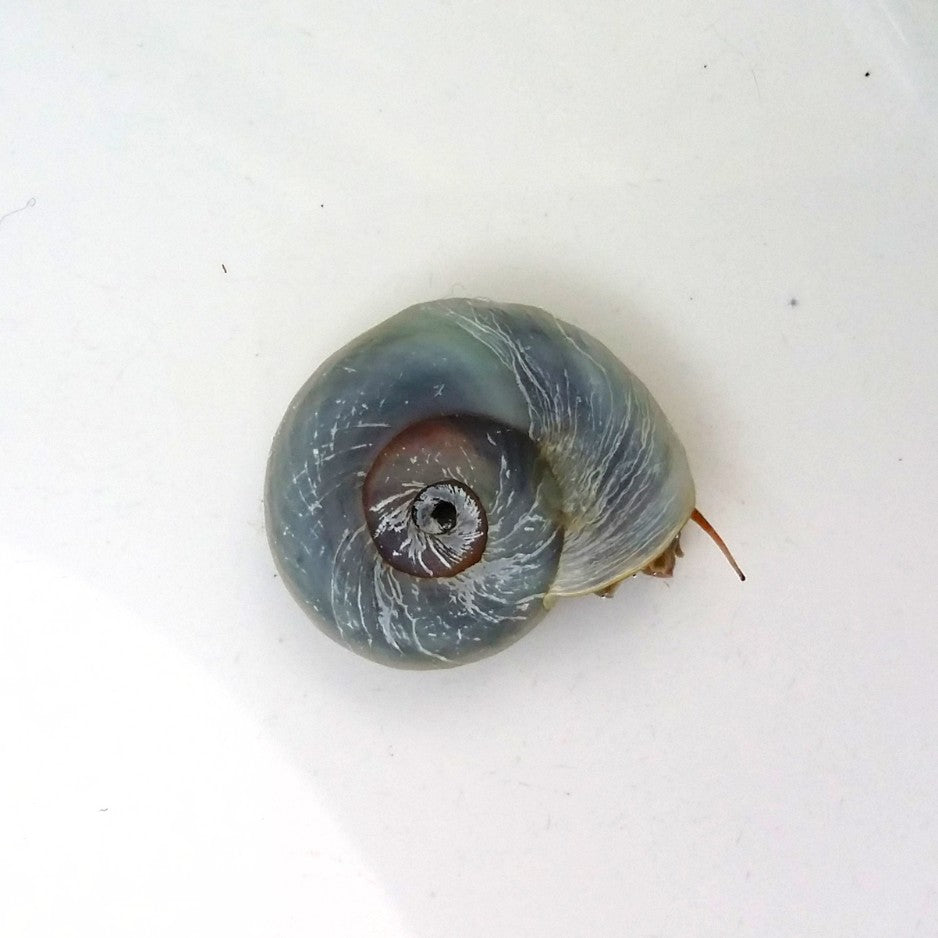
Blue ramshorn snail: colorful cleaning snail for a natural aquarium
What is a blue ramshorn snail?
The ramshorn snail is a freshwater snail with a flattened, disk-shaped shell (flat spiral). Diurnal, it is easy to observe on the glass, plants, and all decorative elements. It respects healthy plants and feeds mainly on debris, algae, and biofilm. Its adult size is 1 to 3 cm in diameter, and its growth is fairly slow. It has lungs and therefore breathes at the surface, but also—and especially—in the water through its skin. It can survive winter outdoors in a pond and reproduces according to the abundance of available food.
Wild ramshorn snails are brown, but this superb variety is a blue mutation.
Why choose blue ramshorn snails for a natural aquarium?
- “Cleaning” snail: as a detritivore, the ramshorn snail helps limit microalgae and waste.
- Low-tech balance: it contributes to the natural recycling of all kinds of organic waste because it is a detritivorous species.
- Rare aesthetic appeal: its absolutely remarkable color is very uncommon in aquariums.
- Compatibility: it lives perfectly well with fish, shrimp, and all microfauna, such as water lice. Its waste can be used to enrich the water in your daphnia cultures.
- Easy care: no special requirements and broad tolerance. The shell is simply more beautiful in hard water.
- For ponds: overwintering is possible; the ramshorn snail withstands all temperatures.
Who are blue ramshorn snails intended for?
- Beginners and experienced aquarists seeking a useful, hardy snail whose population adjusts to needs.
- Low-tech tanks and community aquariums: it is an essential link in the cycle, since it breaks down waste without being vulnerable to fish.
- Shrimp tanks, where it consumes biofilm, shrimp molts, and leftover food.
- Outdoor ponds and container ponds, where its size and shell protect it from fish appetites.
Introduction and care tips
- Simple acclimation at room temperature. Introduce them gradually, taking care to avoid thermal shock.
- Food: waste, algae, and biofilm. There is no need to provide specific food.
- The population is regulated by the available food. If food becomes scarce, adult ramshorn snails eat the eggs or larvae. This is how the population adjusts to the amount of waste. These snails only proliferate when waste is abundant.
- Reproduction: a hermaphroditic species that requires mating. Each individual is both male and female but cannot fertilize itself. Translucent egg masses are continuously deposited on hard surfaces (leaves, glass, and stones). Very often, your snails will already have laid eggs in their transport bag!
- Pond: possible year-round; this is a hardy and resilient species. Its role there will be essential, as organic matter recycling in ponds is intense.
FAQ – Blue ramshorn snail
Does it eat plants?
No, it never attacks healthy plants. It feeds on damaged leaves (and therefore affected tissue), algae, various organic waste, and biofilm.
Is it compatible with shrimp and fish?
Yes, coexistence is perfectly peaceful. Only certain fish specialize in eating snails.
Can it overrun the aquarium?
The population follows food availability. Avoid overfeeding and remove excess food. Their proliferation is not a problem, but a response to the problem!
Lifespan?
Two years, or even longer under good conditions.
Does it really help control algae?
It grazes on microalgae, emerging algae, and biofilm, so it is useful for prevention in a balanced tank.
Are other colors available?
Yes, we also offer completely pink individuals, as well as the wild type, which is brown.
Additional information
- Scientific name: Planorbarius duryi
- Size: 1 to 2 cm, rarely 3 cm.
- Use: detritivorous snail for aquariums and ponds
- Advice: Never pull on the shell to detach them from a surface (or from the bag). Instead, tap the shell gently with your finger to make them release their grip.
- Packaging: snails packed in a sealed bag, with an amount of water and air suited to their number.
- Guarantee: our snails are raised under natural aquarium-keeping conditions. They are collected and packaged on the morning they are shipped.
- Recommendation: please never release these snails into the wild, even though they may sometimes occur there naturally. Our aquatic ecosystems are very fragile.