
Feeding daphnia to your fish: 7 points to know
F. Mattier
1 – The daphnia is a freshwater crustacean
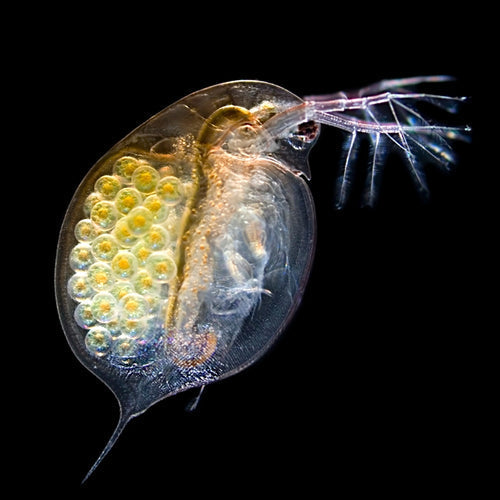
Unlike the brine shrimp (sea water shrimp), the daphnia is part of the natural diet of freshwater fish in the wild. Its microbiome is fully adapted to this non-salty environment. It lives and reproduces there as long as it is not eaten, unlike the brine shrimp. Daphnia nauplii are about twice as small as brine shrimp nauplii (0.2 mm versus 0.4 mm).

2 – The daphnia is rich in proteins
Analyses show a very high protein content, approaching 60%. This explains the lower value of dried daphnia, as some fragile proteins are broken down by drying. A live daphnia exactly meets the nutritional needs of almost all fish, which have adapted to it over millennia. A study showed a 150% faster growth (more than double) between fry fed daphnia and others fed dry food.

3 – Almost all females
Almost all daphnia are females. They reproduce by parthenogenesis, each daughter being a clone of her mother: females giving birth to females! When conditions become difficult (for example before winter), daphnia produce some males and then reproduce, one last time, sexually. They then lay black eggs (stuck in pairs) called ephippia, which survive for a long time waiting for favorable conditions to return. A breeding is therefore often not lost, even if no daphnia are visible anymore!
4 – Eater of green water
The daphnia feeds primarily on phytoplankton, that is, microscopic algae suspended in the water. It feeds by filtering the green water, hence its use to fight green water in aquariums.
In the absence of phytoplankton, the daphnia can settle (as a second choice) for bacteria, yeasts, or even organic matter dissolved in the water.
5 – A varied microbiome
The daphnia is a small animal, but just as complex as a larger one. For example, its digestive tract is inhabited, like ours, by a microbiome. Like ours, it is all the more complex when it is healthy and properly fed. This rich microbiome is partly released into the water with the daphnia’s excrement. The water in which daphnia have lived, even when they are no longer visible, is therefore alive and carries a host of bacteria useful to the aquatic ecosystem.
6 – An animal highly sensitive to light
It has been discovered that daphnia, which move in clouds like fish swim in schools, change their position in the water column according to light, both day and night. Scientists explain that the decline of daphnia in natural environments is the result of light pollution caused by humans, which strongly disturbs them at night.
7 – The chameleon daphnia
It is very difficult to determine the species of some daphnia (there are hundreds), as their appearance can vary so much. Depending on diet, season, climate, etc., the same species will have neither the same size nor the same shape. It has even been noticed that in the presence of fish in their environment, daphnia develop a longer spiny spur, making them less attractive to fish.

17 comments
Bonjour. J’ai introduit des daphnies dans mon bassin naturel mais il est envahi de notonectes qui me mange les daphnies. Comment créer un équilibre ? Merci de vos conseils. Belle journée à vous
J ai un bassin de 5000 l peuplé uniquement de poissons rouges , combien faut il que j achète de poches de daphnies 1ou 2 ??
Merci
Bonjour,
J’ai un petit bac, sans poisson, uniquement végétaux, daphnies et ostracodes. 2 planorbes et des physes qui se sont introduits de façon clandestine et qui se multiplient… du jour au lendemain, j’ai perdu toutes les daphnies et ostracodes 2/3 semaines après l’introduction… Vous avez une idée ? ai-je introduit par inadvertance un produit toxique en plongeant ma main dans le bac ? liquide vaisselle par exemple, savon pour les mains… pas assez rincé ? ou ça peut venir d’autre chose ? merci
j’ai créé un bassin (1000L) enterré avec faune et flore : à ce jour 0 moustiques (car petits poissons même pas nombreux!) et blindé de daphnies petites et grosses. L’eau est “relativement” claire, j’ose même pas imaginer l’état aujourd’hui sans celles-ci.
je viens de recevoir mes daphnies, mais pas de facture dans mon colis. Auriez-vous la gentillesse de m’en procurer un sur mon compte?
Merci à vous et trèsbonne journée