
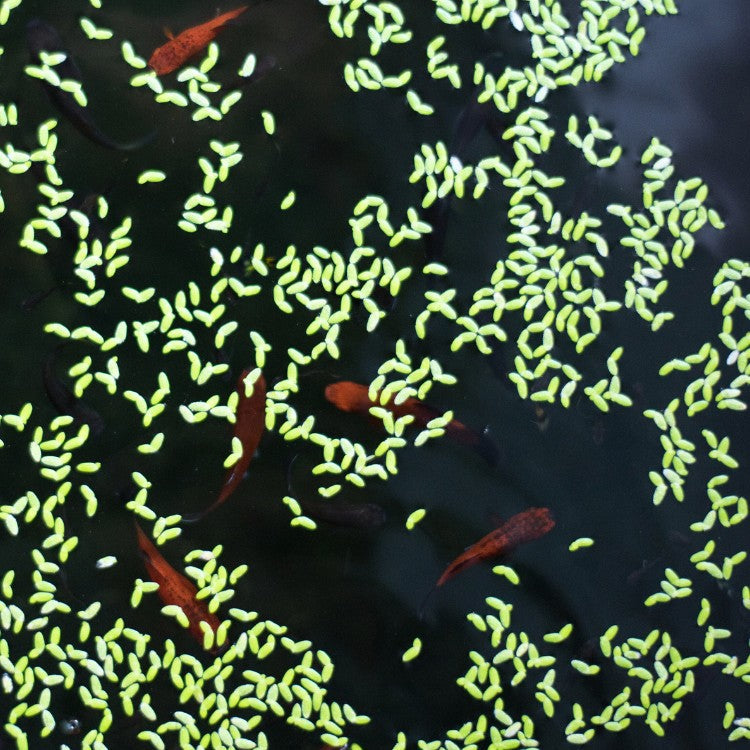
Duckweed for my fish
F. MattierSome fish, like goldfish for example, need a significant plant-based intake. It is even vital for them. And what if duckweed was the natural solution?

The core of the aquatic food chain relies on predation.
Almost all of our fish are what we call micro-predators. In the wild, their food is almost exclusively made up of small prey. Anything sized to fit their mouth is huntable!
And since our aquarium fish are rather small (nothing like groupers, eels, or pikes!), their daily diet is nearly 100% made up of daphnia, mosquito larvae or other insects laying eggs in the water, various ostracods, Blackworm, enchytraeids or Grindals from flooded banks, tubifex living on the bottom, and even water lice or scuds for the larger ones (cichlids for example).

As we saw in this article, fish metabolism is indeed designed to eat proteins, meat, and thus small creatures.
Yet, some fish species appreciate a plant-based supplement more than others.
Some fish also consume plants
We have all seen our guppies and other platys nibble on plant leaves, rocks, and glass to eat the tiny algae growing there. Not enough to eliminate algae, but it is clear that a bit of greenery, even very little, is sometimes sought after. Perhaps it is for lack of better for a guppy for example, which would prefer small worms or daphnia, but it is at least "edible" for it!

And since, in nature, hunting results are uncertain, supplementing with what is found is often necessary. In times of scarcity, they eat what they find, and their intestines are thus adapted to process these poor foods.
Why goldfish are largely plant-eaters
But some fish have a real need for greenery.

This is the case, for example, of our goldfish and koi carp.
Their intestine is very long, which is typical of plant-eaters.
They also have no stomach! All their digestion is done by this long intestine, and thus by the bacterial flora that makes up their internal microbiota.
This means that the richness of this microbiota must be maintained by natural and non-sterile food (live and non-industrially treated food).
Only the bacteria in their intestine break down the food, not a stomach, since it is absent.
And these bacteria need fibers to feed on, somewhat like those in our large intestine. A diet too poor in fibers risks making these essential bacteria disappear, leading to diseases and various disorders.

This is even more true for the most bred forms of goldfish, whose "compact" shape makes transit more difficult and can even cause severe constipation, or swim bladder disorders.
The role of plant fibers as "ballast" then adds to the microbiota issue, becoming essential to the goldfish's survival.
Giving plants to your goldfish, but which ones?
One option is, as many aquarists do, to give vegetables "blanched" in boiling water. They are thus softened and edible for the goldfish or koi carp.
But this is only a stopgap since boiling water kills bacteria and these fish are not made to eat land plants.
So, the best is to observe their natural behavior.
And if you place fish in a pond, you quickly notice that duckweed retreats!
Not the other plants. Almost only the duckweed.

It even happened to me, in my outdoor ponds, to use my goldfish to clear certain plants of the duckweed that was invading them!
Nothing surprising really: duckweed is both rich in plant fibers and proteins.
So much so that it is increasingly considered for human vegetarian food…
Goldfish serve the pond by eating duckweed, thus preventing it from taking over the entire surface. This would deprive other plants of light and kill them.
And duckweed serves the pond by efficiently consuming nitrates, turning them into excellent proteins for our goldfish!
It is a win-win game, as nature has its secret.
Fresh duckweed, the ideal food for goldfish.

Goldfish kept in aquariums, while waiting for the ban on the harmful round bowl, greatly benefit from the regular distribution of duckweed. A simple well-placed bucket is enough to grow it, and it is therefore much easier than growing lettuces!
You thus please them, and above all give them one of the best foods for their metabolism.

A goldfish (or a koi carp) fed largely with duckweed does not have these terrible intestinal or swim bladder problems, often fatal.
And above all, it loves it.
In a balanced pond, the goldfish eats the duckweed, then its droppings, broken down by bacteria, in turn feed duckweed. The virtuous biological cycle is complete and endless.
Pleasure and good health go hand in hand!
1 comment
Bonsoir je viens d’acquérir un lot de poissons rouges, il y en a un avec un ventre énorme, je les mis en quarantaine pour éviter qu’il contamine les autres