
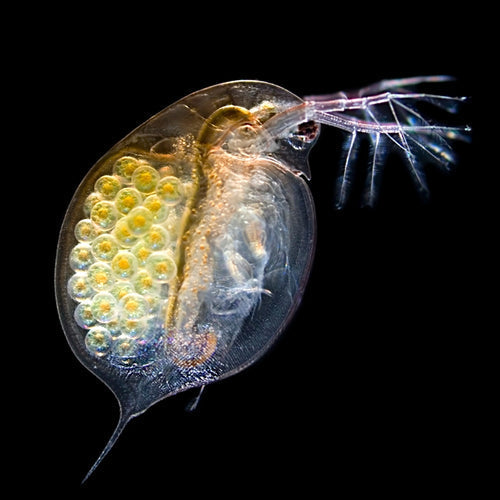
Feeding daphnia to your fish: 7 points to know
F. Mattier
1 – The daphnia is a freshwater crustacean
Unlike the brine shrimp (sea water shrimp), the daphnia is part of the natural diet of freshwater fish in the wild. Its microbiome is fully adapted to this non-salty environment. It lives and reproduces there as long as it is not eaten, unlike the brine shrimp. Daphnia nauplii are about twice as small as brine shrimp nauplii (0.2 mm versus 0.4 mm).

2 – The daphnia is rich in proteins
Analyses show a very high protein content, approaching 60%. This explains the lower value of dried daphnia, as some fragile proteins are broken down by drying. A live daphnia exactly meets the nutritional needs of almost all fish, which have adapted to it over millennia. A study showed a 150% faster growth (more than double) between fry fed daphnia and others fed dry food.

3 – Almost all females
Almost all daphnia are females. They reproduce by parthenogenesis, each daughter being a clone of her mother: females giving birth to females! When conditions become difficult (for example before winter), daphnia produce some males and then reproduce, one last time, sexually. They then lay black eggs (stuck in pairs) called ephippia, which survive for a long time waiting for favorable conditions to return. A breeding is therefore often not lost, even if no daphnia are visible anymore!
4 – Eater of green water
The daphnia feeds primarily on phytoplankton, that is, microscopic algae suspended in the water. It feeds by filtering the green water, hence its use to fight green water in aquariums.
In the absence of phytoplankton, the daphnia can settle (as a second choice) for bacteria, yeasts, or even organic matter dissolved in the water.
5 – A varied microbiome
The daphnia is a small animal, but just as complex as a larger one. For example, its digestive tract is inhabited, like ours, by a microbiome. Like ours, it is all the more complex when it is healthy and properly fed. This rich microbiome is partly released into the water with the daphnia’s excrement. The water in which daphnia have lived, even when they are no longer visible, is therefore alive and carries a host of bacteria useful to the aquatic ecosystem.
6 – An animal highly sensitive to light
It has been discovered that daphnia, which move in clouds like fish swim in schools, change their position in the water column according to light, both day and night. Scientists explain that the decline of daphnia in natural environments is the result of light pollution caused by humans, which strongly disturbs them at night.
7 – The chameleon daphnia
It is very difficult to determine the species of some daphnia (there are hundreds), as their appearance can vary so much. Depending on diet, season, climate, etc., the same species will have neither the same size nor the same shape. It has even been noticed that in the presence of fish in their environment, daphnia develop a longer spiny spur, making them less attractive to fish.

17 comments
@David : si l’eau sent mauvais, c’est qu’elle ne contient plus d’oxygène et que des composés réduits se sont formés. Cela peut être la cause de la disparition des daphnies, et cela se produit généralement lorsqu’un excès de matière organique morte se décompose rapidement. Les bactéries deviennent innombrables et respirent tout l’oxygène. Lorsque des populations de daphnies très denses meurent pour une autre raison, elles se décomposent pareillement et, dans ce cas, l’odeur forte est la conséquence et non la cause.
Mais le plus probable est l’excès de matières organiques. Cela se produit très souvent lorsqu’on nourrit trop en une seule fois et que les daphnies ne mangent pas tout.
Moe : c’est bien sûr impossible à dire, mais la piste que vous soupçonnez est parfaitement possible. Les détergents modifient grandement les propriétés mécaniques de l’eau (c’est un peu leur but), même à faible dose, et sont vraiment un danger.
Kermit : 👍
Vous avez raison, Nadège, les larves de moustiques sont une concurrence pour les daphnies, puisqu’elles ont la même alimentation à peu de choses près. Il faut donc favoriser les daphnies en prélevant les larves de moustiques. Votre peau, en plus, vous remercie !
Nathalie : une bonne part de la faune aquatique se nourrit en effet de daphnies, qui sont à la base de la chaîne alimentaire, juste après le phytoplancton. Notonectes, mais aussi dytiques adultes ou larves, larves de libellules, et même les gammares ! À part couvrir son bassin d’une moustiquaire (en encore !), il n’y a pas beaucoup de solutions. En présence de gros poissons, ces prédateurs des daphnies seront à leur tour mangés. Normalement, il reste toujours quelques individus, ou des œufs, pour repartir à l’automne ou au printemps suivant. L’été, elles sont plus rares, même dans la nature.